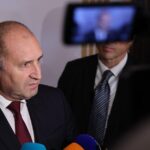
In statements on November 13, opposition parties slammed Bulgarian Prime Minister Roumen Radev over Bulgaria’s position to support “with reservations” France’s initiative on key principles of European security, presented in Dublin.
While some media reports said that Bulgaria was alone among EU countries in not signing the declaration, the website of the President of France showed Bulgaria among the signatories, and the Bulgarian government information service said that the country had supported it, with reservations about the preamble.
Daniel Mitov, an MP for Boiko Borissov’s opposition coalition GERB-UDF and a former foreign minister, said that Bulgaria continues to pursue an unclear foreign policy.
“It was not clear again what he (Radev) signed, what he did not sign and with what reservations,” Mitov said.
“We have Schrödinger’s foreign policy again – we are both there and not there. They never explained what these reservations are,” he said.
“Obviously, Prime Minister Radev is not talking to Bulgarian citizens through such explanations. He is talking to his masters in the Kremlin and giving them a signal that he is actually defending their interests in European formats,” Mitov said.
Borissov said: “Did we sign the declaration or didn’t we? I didn’t understand! German media says we didn’t, the Elysee Palace says we did”.
Ivailo Mirchev, co-leader of opposition coalition Democratic Bulgaria, said: “This is yet another ‘hybrid’ position from Bulgaria—we have joined, yet we haven’t joined”.
“Mr. Radev is clearly afraid of Russia. We ought to treat our partners as a true ally would,” Mirchev said.
Radev, speaking on November 13, said that Bulgaria supported the declaration with reservations only regarding the preamble.
“And we support the declaration in its working part, where we have clearly expressed principles for joint efforts to counter organized crime, terrorism, hybrid attacks, the production and distribution of drugs, and countering illegal immigration,” Radev said.
“But we also take into account that negotiations are currently underway, finally at a high diplomatic level, for a peaceful solution to the war in Ukraine. It is here that we think that the language of common European documents should reflect the dynamics of these political processes, especially when it comes to negotiations,” he said.
“That is why we also expressed reservations about the preamble of the declaration, so that these formulations correspond to these dynamics. So that we can have a broader scope of dialogue and not exclude peaceful solutions in their entirety.”
Radev said that in the earlier versions, there was a formulation about the importance of the negotiations in Abu Dhabi “and that we should support them, then that disappeared, dropped out”.
“We insist on having such a text, to take it into account and not to narrow the field for dialogue and the options for finding a solution. We supported this declaration with reservations only in the preamble. What we have reservations about – these are the formulations in light of the negotiations that have already begun. This is an adopted document by Bulgaria and we welcome it, my reservations to the preamble are recorded.”
Regarding Bulgaria’s position on a new EU loan for Ukraine, Radev said: “Our position is clear – we support all efforts for peace”.
“I do not accept the imposition of the position for peace from a position of force, because we saw a year and a half ago, when I stated it, that this will only lead to more victims, more destruction and an even greater escalation of the conflict, which is already a risk not only for Europe, but for the entire world,” he said .
“We must take into account that Bulgaria, unlike other EU member states, is the country with the largest historical community in Ukraine. And we are deeply concerned by the fact that Bulgarians continue to die in this war every day,” Radev said.
“And that is why we want peace to be restored as quickly as possible. The task of our government is to help our compatriots in Ukraine live in peace as soon as possible, but also to have access to education, healthcare, electricity, and heating during this transitional period. And this will not be solved by investing in military means.”
Radev again referred to Bulgaria being in an excessive deficit procedure, as he has before when speaking about assistance for Ukraine.
“We are in an excessive deficit procedure. We have problems with the reserves in the state. And we have no way in this situation to provide financial resources, but in no case do we hinder the decisions of other member states,” he said.
“Whoever decides to help and invest financial resources in whatever they decide. So we are not blocking anyone in this situation,” Radev said.
“We are ready to talk about mechanisms that will guarantee that these funds will not go to weapons, but to humanitarian activities, to support with electricity, to medical activities, and this is very important for us – we want to see mechanisms that will target these funds, if we invest such as a guarantor, to go specifically to our community. It is compactly expressed in several regions of Ukraine,” he said.
(Photo: government.bg)